What Are the Kerala Backwaters?
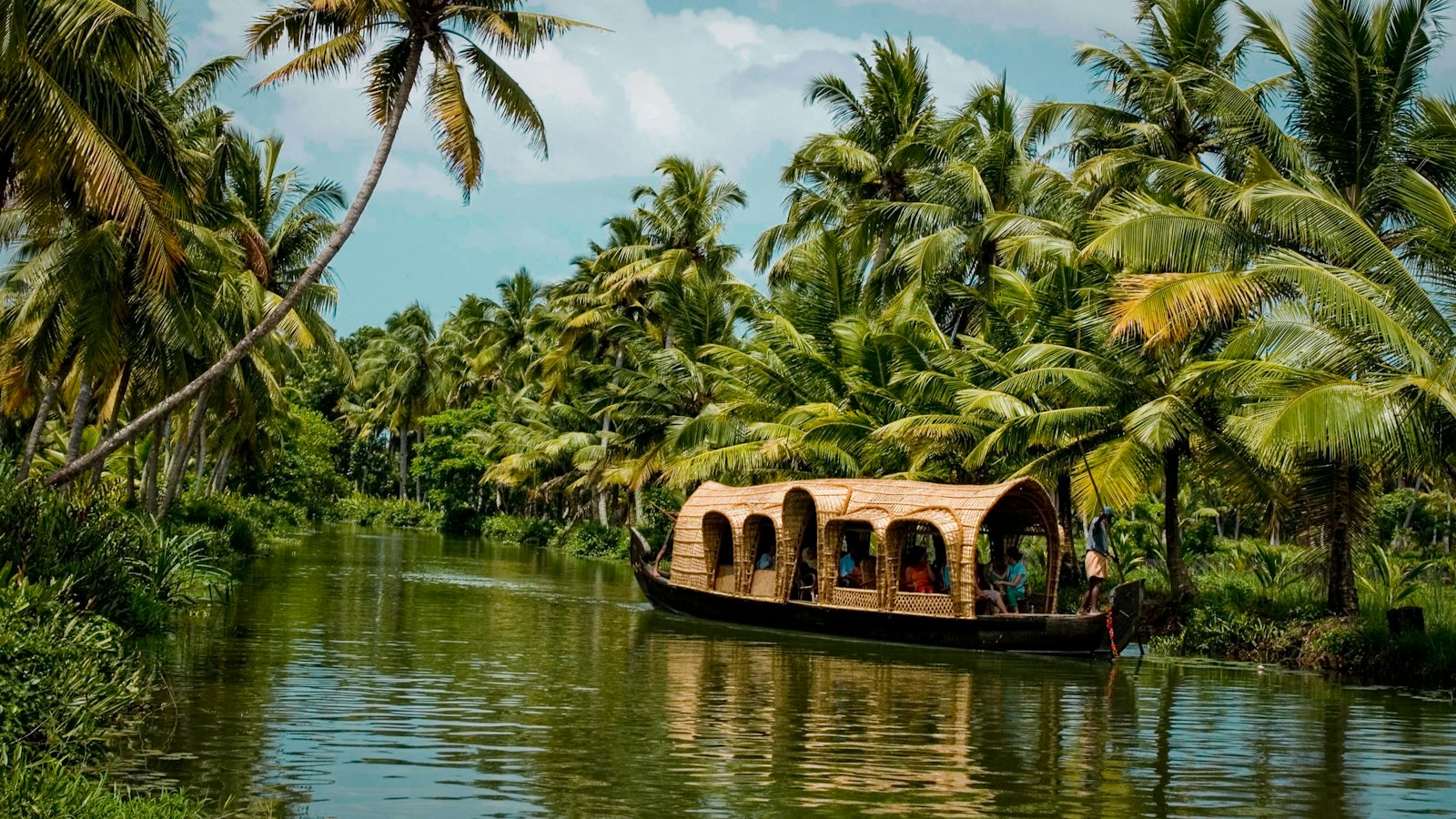
The Kerala backwaters are one of the most extraordinary waterscapes on earth — a labyrinthine network of over nine hundred kilometres of interconnected canals, rivers, lagoons, and inlets that stretch along the Malabar Coast of southwestern India. Fed by thirty-eight rivers flowing westward from the Western Ghats and five vast lakes, this brackish tidal system sustains an entire civilisation on its banks: rice paddies shimmering beneath coconut canopies, villages accessible only by boat, and a rhythm of life that has remained essentially unchanged for centuries.
At its heart lies Vembanad Lake, the longest lake in India, whose glassy surface mirrors the sky with such perfection that the horizon dissolves entirely. Here, the traditional kettuvallam — rice barges once used to transport grain from the hinterlands to the coast — have been reimagined as floating luxury suites, gliding silently through waterways so narrow that the palm fronds brush the deck. To travel the backwaters is not simply to see Kerala but to inhabit it: the soft lap of water against the hull, the flash of a kingfisher in the reeds, the distant sound of temple bells carrying across the lagoon at dusk.
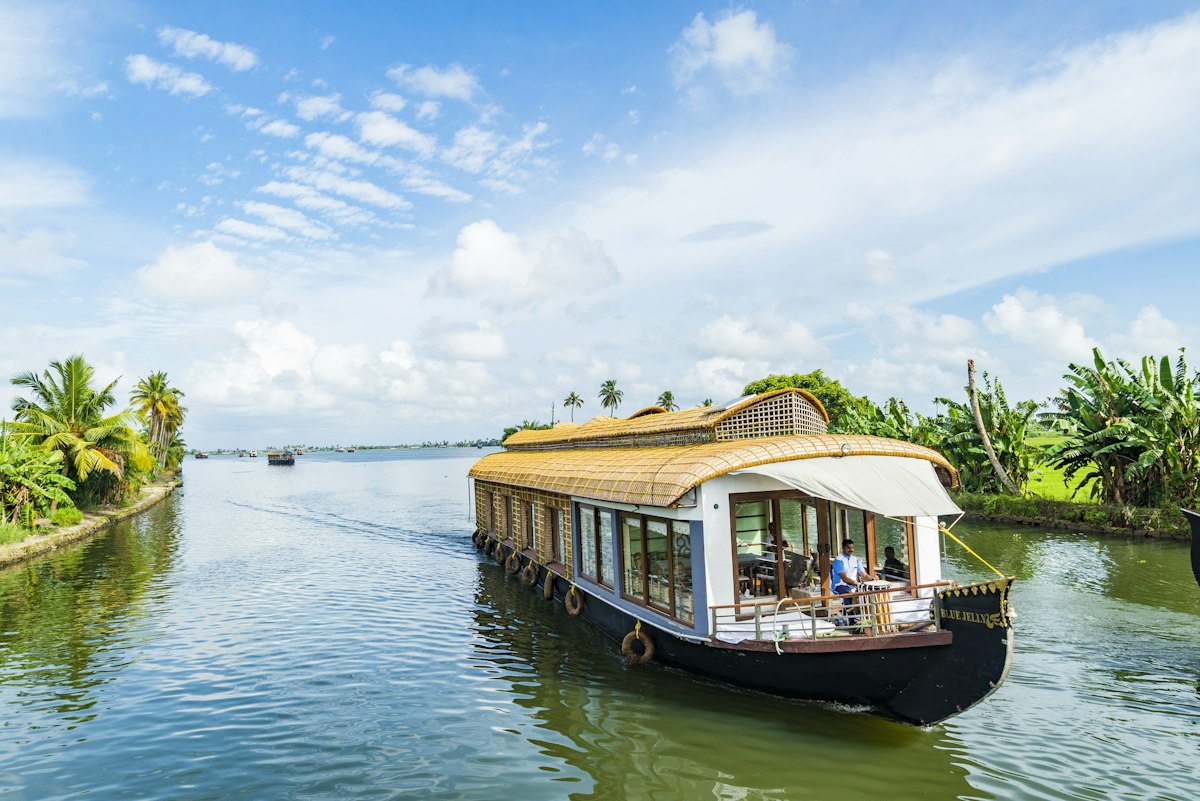
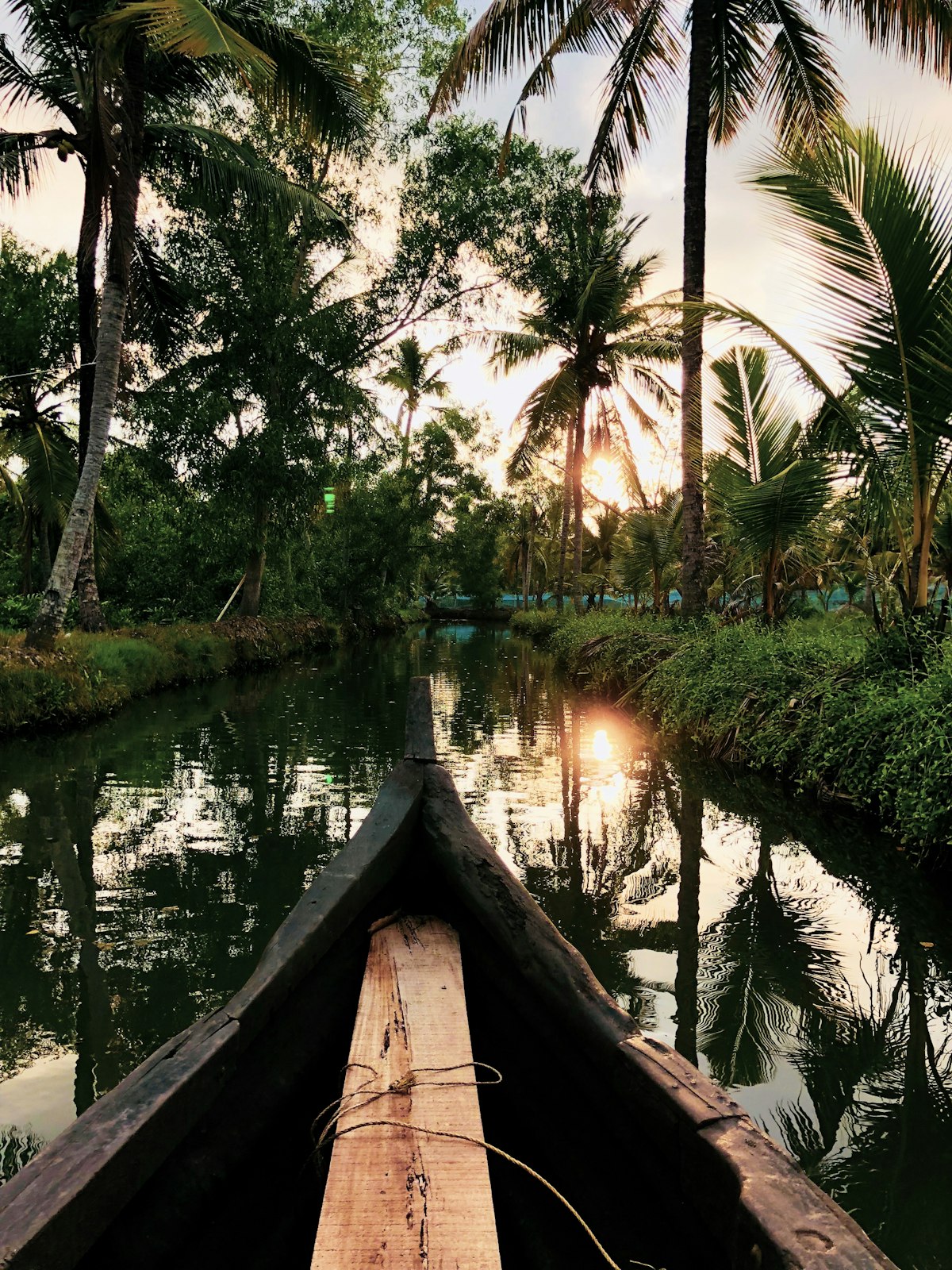
For the luxury traveller, the backwaters offer something increasingly rare in our accelerating world: genuine stillness. There is no Wi-Fi signal in the narrower channels, no road noise, no crowds. Only the patient geometry of coconut palms reflected in water the colour of burnished bronze, and the unhurried grace of a culture that measures its days not by the clock but by the tide.
Houseboat vs. Luxury Resort — Which Is Right for You?
The Houseboat Experience
The kettuvallam houseboat is Kerala's signature experience and, at its finest, among the most memorable nights one can spend anywhere in India. These traditional rice barges have been exquisitely converted into floating hotel suites — the best feature air-conditioned bedrooms with full-length windows, open-plan living areas with cane furniture and local textiles, and a private deck with rattan loungers from which to watch the backwaters unfold before you. A private chef prepares Kerala cuisine on board: karimeen pollichathu (pearl spot fish wrapped in banana leaf), appam with coconut milk stew, and freshly caught prawns seasoned with Malabar pepper.
The finest houseboats operate on the quieter canals south of Alleppey, away from the busier tourist routes, offering a voyage through village life that feels genuinely intimate. We recommend a minimum one-night stay — two nights for those who wish to explore the deeper, less-visited waterways that lead toward Kumarakom and the Kuttanad rice paddies, where the land actually lies below sea level.
Our Recommendation
Combine a one-night luxury houseboat cruise with two or three nights at a lakeside resort. This pairing gives you the immersive, on-the-water experience alongside the full-service amenities — Ayurvedic spa, curated excursions, and the comfort of a permanent address — that a resort provides.
The Luxury Resort Stay
Kerala's finest backwater resorts rank among the most distinguished properties in all of India. Unlike the transient magic of a houseboat, a resort stay offers the full continuum of luxury: sunrise yoga overlooking the lake, morning birdwatching expeditions, long afternoons in the Ayurvedic spa, and candlelit dinners where the chef draws from a kitchen garden steps from your table. The architecture at the best properties is itself a masterwork — heritage wooden mansions reassembled plank by plank on the lakeside, thatched-roof villas surrounded by lotus ponds, and infinity pools that appear to merge with the backwaters beyond.
The Best Time to Visit Kerala
Kerala's climate is tropical, and the backwaters are at their most magnificent from September through March. The monsoon recedes in September, leaving the landscape at its most verdant — every shade of green imaginable, the canals full and flowing, the air washed clean. October through February is the peak season: temperatures hover between 23°C and 32°C, skies are generally clear, and the humidity is at its most bearable. March remains comfortable, though the heat begins to build.
The monsoon months of June through August bring torrential rainfall, and while this period has its own dramatic beauty — the landscape explodes with life, and Ayurvedic treatments are traditionally considered most effective during the rains — houseboat cruises and outdoor activities are significantly curtailed. April and May are the hottest months and generally not recommended for first-time visitors.
Insider Timing
Late September and early October offer an exceptional window: the monsoon has just lifted, the backwaters are at their highest and most lush, tourist numbers are still low, and the prices at top properties are often more favourable than during the December-January peak. This is when Kerala reveals its most authentic, unhurried character.
Top Experiences in Kerala
1. Luxury Houseboat Cruise
The centrepiece of any Kerala journey. A private overnight cruise through the palm-fringed canals of Alleppey or Kumarakom offers an unparalleled immersion in the rhythms of waterside village life. Watch toddy tappers scale coconut palms at dawn, fishermen casting Chinese nets against the amber light, and children paddling canoes to school. The finest boats come with a private crew of three — captain, chef, and attendant — and can be customised with champagne sundowner cruises, private cultural performances, or early-morning birdwatching with a naturalist.
2. Ayurvedic Spa Retreat
Kerala is the birthplace of Ayurveda, the ancient Indian science of life and longevity, and nowhere else in the world can one experience it so authentically. The finest Ayurvedic centres — Kalari Kovilakom, Somatheeram, and the spa at Kumarakom Lake Resort — offer treatments that go far beyond the superficial: multi-day programmes designed by Ayurvedic physicians, beginning with a detailed consultation to determine your dosha (constitutional type) and culminating in bespoke therapies using herbal oils, medicinal herbs, and techniques refined over three thousand years. A minimum three-night Ayurvedic programme is recommended for meaningful results.
3. Spice Plantation Visit
The spice gardens of Thekkady and Munnar — where cardamom, pepper, cinnamon, clove, and vanilla grow in lush profusion on the slopes of the Western Ghats — are among Kerala's most fragrant and revelatory experiences. A private guided walk through a working plantation allows you to see, touch, and taste the spices that have drawn traders from Rome, Arabia, and China to this coast for over two millennia. The best visits include a farm-to-table lunch where the chef demonstrates how each spice transforms the cuisine, and a chance to purchase single-estate spices directly from the grower.
4. Kathakali Dance Performance
Kathakali is Kerala's great classical dance-drama — a spectacle of extraordinary visual intensity in which performers, their faces painted in vivid geometric patterns of green, red, and gold, enact episodes from the Hindu epics through an elaborate vocabulary of gesture, expression, and movement. The preparation alone is a performance: watching the artists apply their makeup over two hours, layering rice paste and pigment with meditative precision, is as captivating as the dance itself. We arrange private performances at heritage venues in Cochin, where the intimacy of the setting allows you to appreciate every nuance of this ancient art form.
The Finest Luxury Properties in Kerala
Kumarakom Lake Resort
Set on the banks of Vembanad Lake in twenty-five acres of lush gardens, Kumarakom Lake Resort is perhaps Kerala's most celebrated luxury property. Its heritage pool villas — reconstructed from centuries-old tharavad mansions — feature private plunge pools overlooking the lake, hand-carved wooden interiors, and open-air bathrooms screened by tropical foliage. The Ayurmana spa offers authentic Ayurvedic treatments overseen by resident physicians, and the resort's location on the lake provides direct access to houseboat cruises and birdwatching excursions at the Kumarakom Bird Sanctuary, home to over a hundred and eighty species.
CGH Earth — Coconut Lagoon
Accessible only by boat across Vembanad Lake, Coconut Lagoon embodies the CGH Earth philosophy of responsible luxury — heritage architecture sensitively restored, organic cuisine sourced from the surrounding villages, and a deep engagement with the local environment. The property's heritage bungalows are original Kerala homes dismantled and reassembled on the lakeside, their carved wooden facades and tiled roofs preserving an architectural tradition that is rapidly disappearing. The butterfly garden, the toddy-tapping demonstration, and the sunrise canoe ride through the canals are experiences of rare authenticity.
CGH Earth — Marari Beach
For those who wish to pair the backwaters with the coast, Marari Beach Resort by CGH Earth occupies a pristine stretch of the Arabian Sea shoreline. Its thatched-roof villas are set amid organic gardens tended by the resort's own farmers, the Ayurvedic centre is among the most respected on the coast, and the beach itself — a broad sweep of golden sand visited more by local fishermen than tourists — offers the kind of solitude that has become Kerala's quiet luxury.
Key Destinations to Include in Your Kerala Journey
Cochin (Kochi)
Kerala's cultural capital and the natural starting point for any journey. The historic Fort Cochin quarter is a palimpsest of colonial influences — Portuguese churches, Dutch palaces, British parade grounds, and the iconic Chinese fishing nets that line the harbour. The Kochi-Muziris Biennale has established the city as a centre of contemporary Indian art, and its restaurants — from street-side toddy shops to refined modern Kerala dining — rank among the finest in South India. Allow two nights to explore at a civilised pace.
Munnar
The former summer retreat of the British Raj, Munnar rises to over 1,600 metres in the Western Ghats, its slopes carpeted with tea plantations that ripple like green velvet in every direction. The cool mountain air is a welcome contrast to the coastal warmth, and the landscape offers exceptional trekking through shola forests and grasslands where the Nilgiri tahr — an endangered mountain goat — can be spotted on the cliffsides. Stay at a heritage tea estate for a complete immersion in the high-altitude tranquillity.
Thekkady & Periyar
Thekkady is the gateway to the Periyar Tiger Reserve, one of South India's most important wildlife sanctuaries, set around a picturesque artificial lake. While tiger sightings are rare, the reserve is home to wild elephants, gaur, sambar deer, and over two hundred and sixty species of birds. A bamboo rafting excursion on Periyar Lake, guided by former poachers turned conservationists, offers one of Kerala's most moving wildlife encounters. The surrounding spice plantations provide an aromatic counterpoint to the forest.
Marari Beach
A serene stretch of the Arabian Sea coast between Alleppey and Cochin, Marari is the antithesis of Goa's party beaches — a quiet fishing village where colourful boats line the shore and the only footprints in the sand are likely to be your own. It is the ideal place to decompress after a houseboat cruise or hill-station visit, with nothing to do but read beneath a palm, swim in warm seas, and dine on the day's catch prepared over coconut-husk coals.
Combining Kerala with Other Regions
Kerala is one of India's most versatile destinations for multi-region itineraries. For a comprehensive South India journey, pair the backwaters with Tamil Nadu's magnificent temple cities of Madurai and Thanjavur, or the ruins of Hampi in Karnataka. A Kerala-Goa combination balances backwater serenity with the beaches and Portuguese heritage of India's smallest state.
For a grand pan-Indian odyssey, many of our guests combine a week in Kerala with Rajasthan's palace circuit or a tiger safari in Central India — the contrast between the lush, tropical south and the arid, monumental north is one of the great revelations of Indian travel. Flights connect Cochin with Delhi, Jaipur, and Mumbai in under three hours, making such combinations entirely practical. Explore our dedicated Kerala Backwaters itineraries for inspiration.
“Kerala does not rush. It drifts, and in the drifting, it teaches you something that no amount of motion ever could — that the most extraordinary journeys are measured not in distance but in stillness.”